
— Baseball is a Game of Movement —
RELAYS
[The ‘Relay’ player can also be referred to as the ‘Cut-Relay’ player. That player doesn’t always Relay the ball. Sometimes they ‘Cut’ the ball and redirect the ball to a different base, or Cut the throw and hold the ball (when runners are no longer attempting to advance, or are clearly going to make it safely to the next base.]
cut-relay to home (mini diamond)


cut-relay to home (full field)
DRILL
Coach
Mix up the location of balls to the outfield, so pitcher’s learn to line up to different spots.
Maintain discipline of the Pitcher and Catcher on their movement and communication responsibilities
Middle Infielder (Second Baseman in this diagram)
Rule: ‘Always Move Towards the Ball’. The Middle Infielder runs out towards the ball hit into the outfield.
Pitcher
Get lined up - Look both ways. Find the ball, look home, get on the line between the ball and home plate
Move out toward the outfielder to a point near the baseline between first and second. Do Not go past the baseline
Call loudly and repeatedly for the ball, in a Ready Position, facing the ball
Catch & Throw - ‘Move feet to catch’, ‘Turn glove side’, move feet, towards catcher, to throw
Outfielder
Field the ball using the same rhythm as fielding a ground ball in the infield: Fast, Slow, Fast
Maintain a ‘Box Mentality’; throw the ball to the Pitcher (Cut-Relay Player)
After throwing the ball, move to back up a base. Be alert for a throw to a base by the pitcher or catcher
Catcher
Move to the catcher’s ‘position’, in front of home plate
Call the play: just before the outfielder fields the ball, call loudly, “Four, Four, Four”
Communicate to Pitcher (Cut-Relay Player), while the ball is in the air between the outfielder and pitcher call and repeat loudly, “Cut Four, Cut Four”
Move Feet to Catch, tag the ground in front of home plate where the base runner would be sliding, then shuffle out towards the middle of the infield, ‘Look for other runners’.
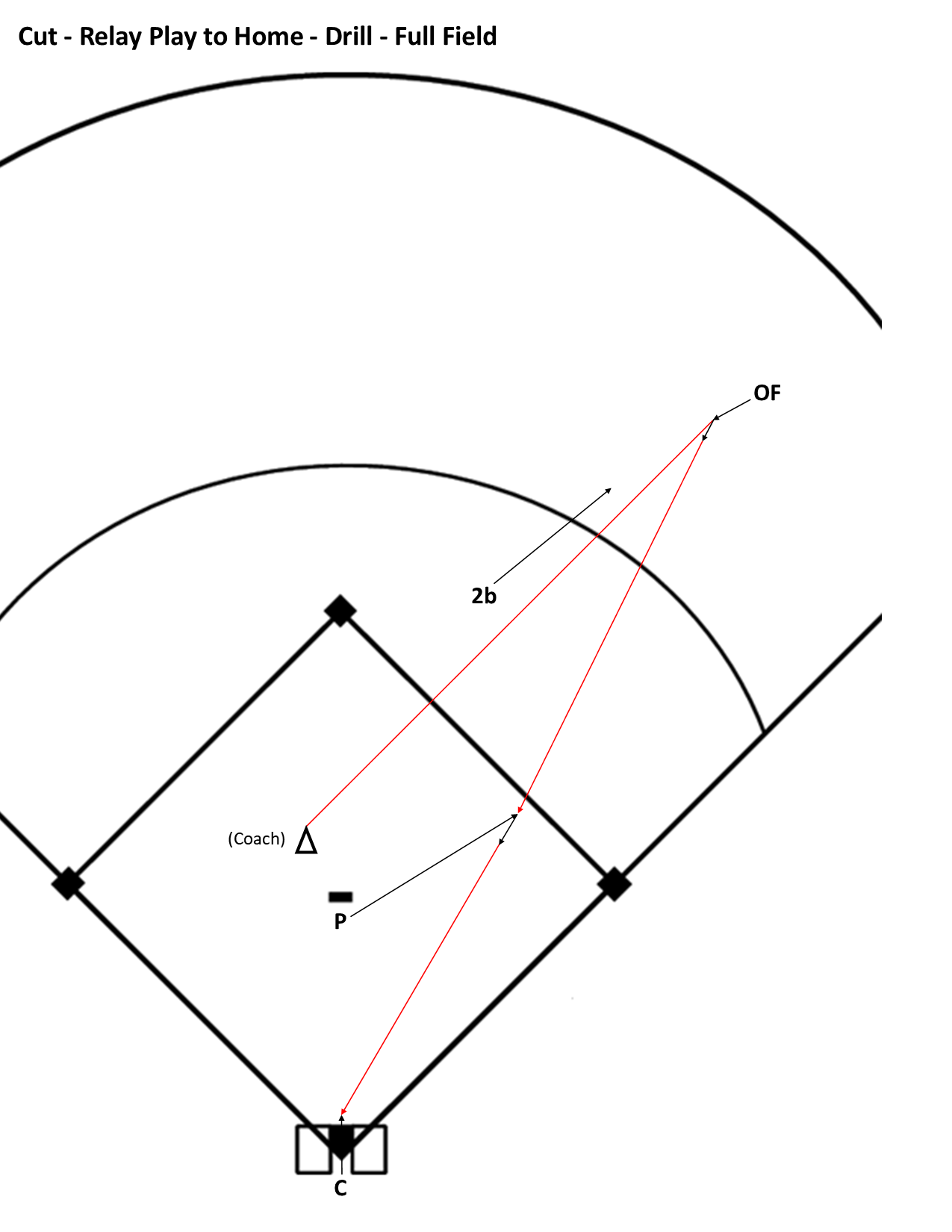
cut-relay to home ("eat it, run it in")


Cut-Relay to Home - Cut 3, 2
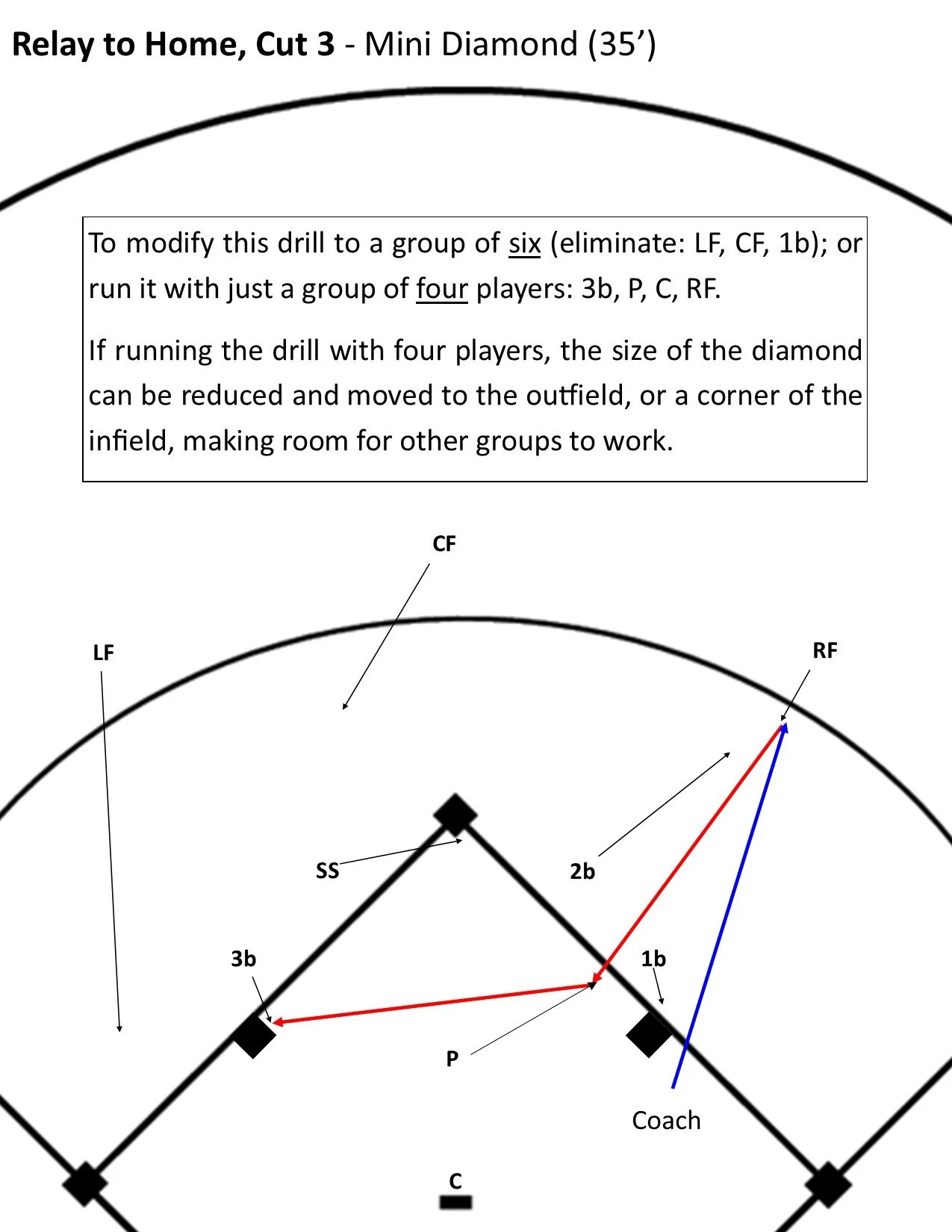


Cut-Relay to Home (Ball Past OF)



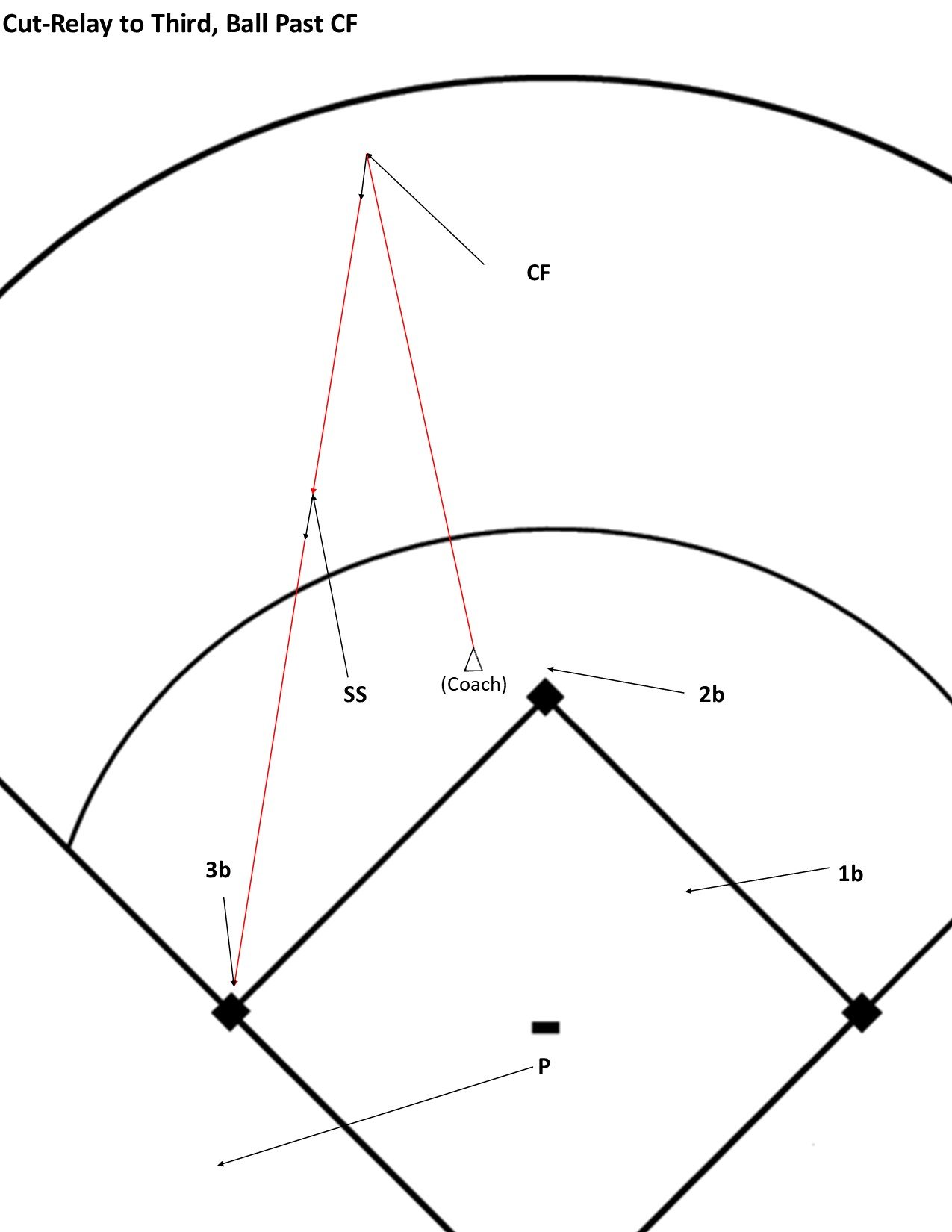
Cut-Relay to Third
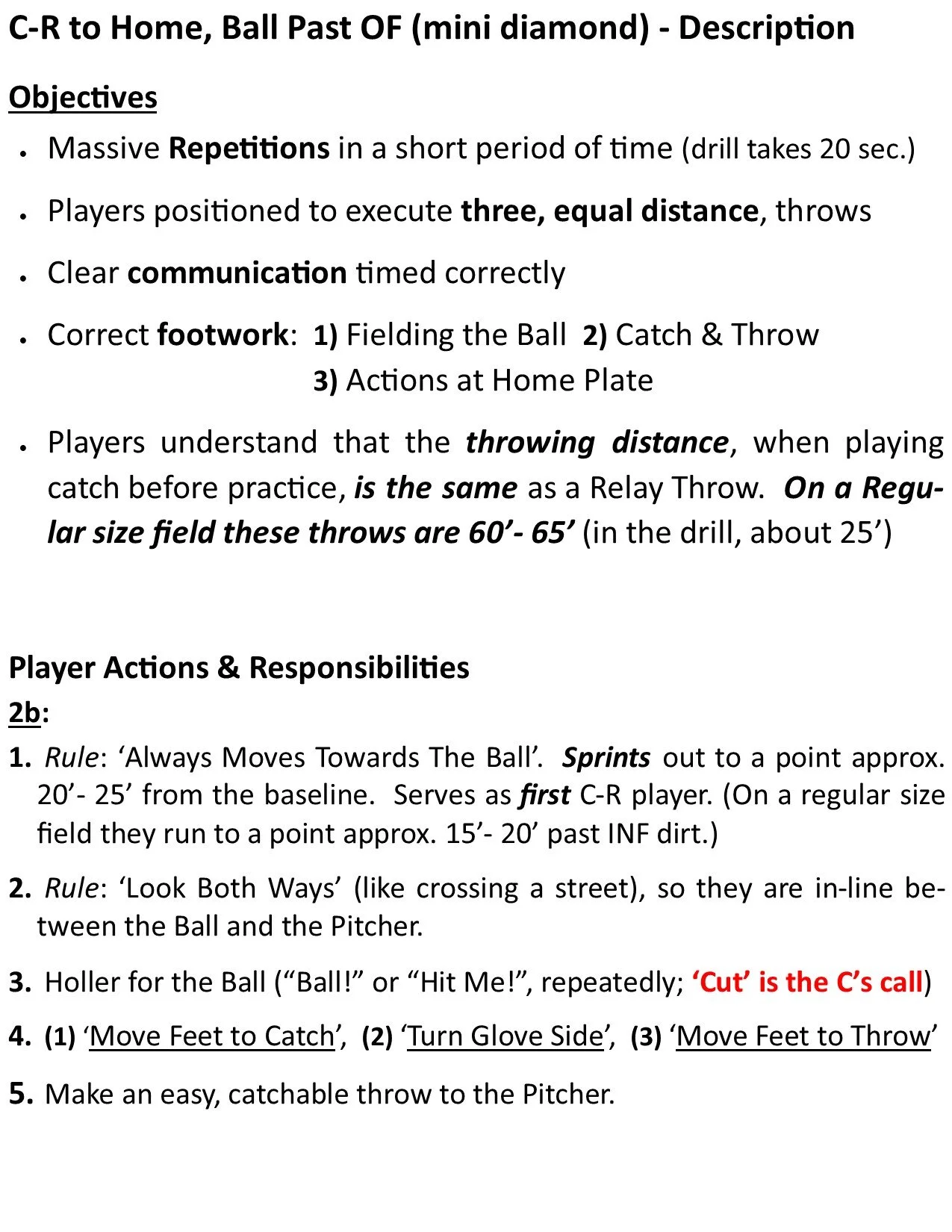
This play should be practiced on the Mini Diamond first. Given practice time limitations during the season, we may not have time to practice the play on the Full Field. The important things the players are learning: movement/positioning and communication. These can be trained on the Mini Diamond. The only skill not addressed in the Mini Diamond scenario is throwing full distance (~55’-65’), which the players work on each day during Playing Catch Practice.
Coach
Toss the ball to a point beyond the Center Fielder.
Center Fielder
‘Box’ Mentality. Get to the Ball quickly. Responsibility is limited to making a good throw to the Shortstop (do not be concerned with the runner(s); that is the responsibility of the Shortstop and Catcher).
Catcher
Get into position to cover ‘Fourth Base’. Wait until the Center Fielder is about to pick up the ball. Assess the situation, call out which base the play is going to; the options are: Third Base or Second Base.
As the ball is in the air to the Shortstop, another call is made. The likely options are:
‘Eat it, Run it In’
‘Cut Three’
‘Cut Four’ (Home Plate)
Shortstop
Moves to a point midway between the Ball and third base. ‘Look both ways’, identifying the location of the ball and third base, then getting in line between those two points.
Second Baseman & Third Baseman
Cover a Base; standing on the same side of the base as the ball.
First Baseman
In this situation, the Batter-Runner is advancing to Second Base (which eliminates the possibility for a throw to First Base). They follow the ‘Ball, Base, Back-up’ rule: They are not getting the Ball, they are not needed to cover First Base, so they default to Backing-up a possible throw to Second Base.
Pitcher*
Back-up third base.
Note: if they hear a call for a throw to home, if possible, they move to a point between the Shortstop and Home Plate. In such case, they likely would not be asked to relay the ball to home plate. It is more likely they would serve as a ‘Cut’, meaning they would cut the ball and redirect it to another base, or ‘Cut and Hold the Ball’ (no play to get an out is possible).
* The complex situation of the runner, who is heading for Third Base, attempting to advance to Home, is pretty much limited to the 11–12-year-old levels of play. In most cases, at lower levels of play, the Pitcher’s responsibility is just backing up Third Base
Communication is critical on balls hit past the outfielders
The assumption on a ball hit past the outfielders is each runner will advance two bases safely. However, a slower runner could be vulnerable… a faster runner might be able to advance three bases.
The possibility of each circumstance is where communication is so important.
Communication starts with the Catcher. When the catcher makes a call for which base to throw to, the infielders ‘echo’ the call to the outfielder. After the infielders hear the Catcher’s call, they ‘relay’ the call to the outfielder.
When the ball is in the air to the Shortstop (assuming the original call was to throw to Third Base), the catcher makes a second call, either:
“Three!, Three!”, meaning: Relay the ball to Third Base, we have a chance of getting an out at that base
“Four!, Four!”, meaning: A runner we anticipated going only to Third Base is trying to score
“Eat it, Run it In”, meaning: The runners will advance safely; we don’t want to make an unnecessary throw. Note: the Shortstop remains vigilant; when they turn to run the ball in, runner(s) may actually attempt to advance to the next base. The Shortstop needs to be ready to make a throw.
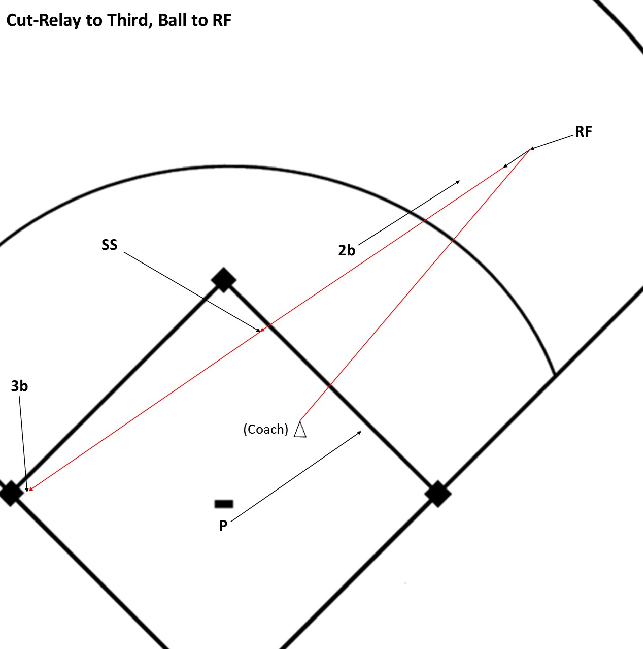
This play should be practiced on the Mini Diamond first. Given practice time limitations during the season, we may not have time to practice the play on the Full Field. The important things the players are learning: movement/positioning and communication. These can be trained on the Mini Diamond. The only skill not addressed in the Mini Diamond scenario is throwing full distance (~55’-65’), which the players work on each day during Playing Catch Practice.
Coach
Toss a ground ball to the Right Fielder.
Right Fielder
‘Box’ Mentality. Get to the Ball quickly. Responsibility is limited to making a good throw to the Shortstop (do not be concerned with the runner(s); that is the responsibility of the Shortstop and Catcher).
Catcher
Get into position to cover ‘Fourth Base’. Wait until the Right Fielder is about to pick up the ball to make the call, “Three!, Three!”, repeatedly. As the ball is in the air to the Shortstop, another call is made, ‘Cut Three’, repeatedly. (In a game situation, when the Catcher determines there is not a possibility of getting the runner out at third base, OR the runner stops at second base, an alternate call of, “Eat it! Run it In” is made.)
Shortstop
(We are assuming the SS identifies that the runner will arrive at second safely; there is no play to be made at second base.) Moves to a point inside the baseline, between the Ball and third base. ‘Look both ways’, identifying the location of the ball and third base, then getting in line between those two points.
Second Baseman
Follows the Rule: ‘Always run towards the Ball’. Run out towards the Right Fielder. In a game situation, if the runners have stopped attempting to advance, the Second Baseman gets the ball from the Right Fielder (ball is handed to the Second Baseman or delivered using an Underhand Toss from a short distance) and Runs the ball back towards the middle of the infield (while remaining alert of the base runners).
Third Baseman
Cover Third Base ‘With Their Eyes’; sets up in a Ready Position, on the same side of the base as the ball. After catching the ball and making a tag, they shuffle towards the middle of the infield, in a Power Position, ‘Looking for Other Runners’.
Pitcher*
Follows the Rule: ‘Always run towards the Ball’. Run out towards the Right Fielder, stopping inside the baseline. ‘Look Both Ways (at the ball and Home Plate), get lined up between the point the ball is fielded and Home Plate. (we are assuming there was a base runner on second base prior to the ball being hit. The Pitcher is now in position to serve as the Cut-Relay player to Home Plate.
In a game, if there is not a runner on second base, the Pitcher Backs-up First Base
Left Fielder (not shown in the diagram)
Back-up Third Base

