
— Baseball is a Game of Movement —
ground balls
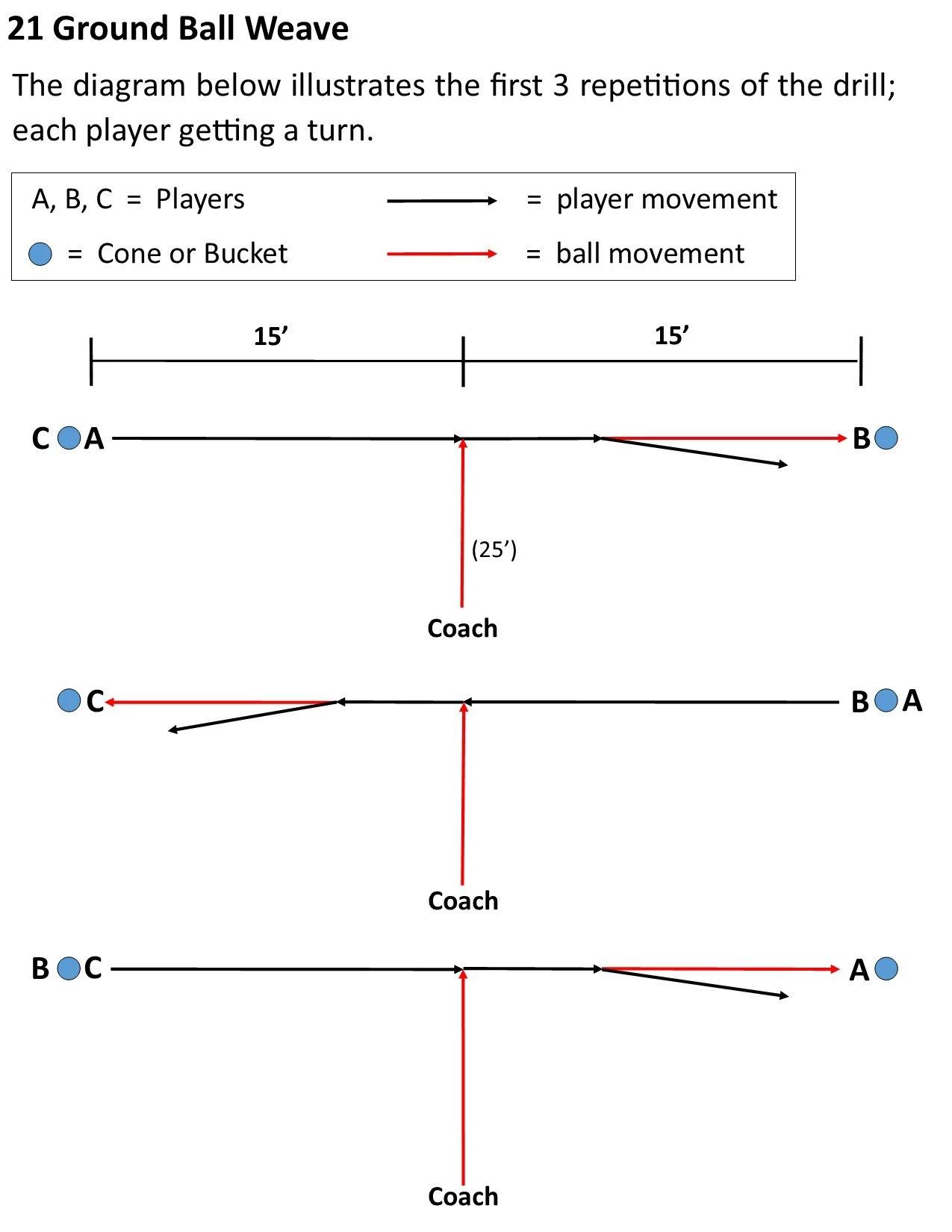
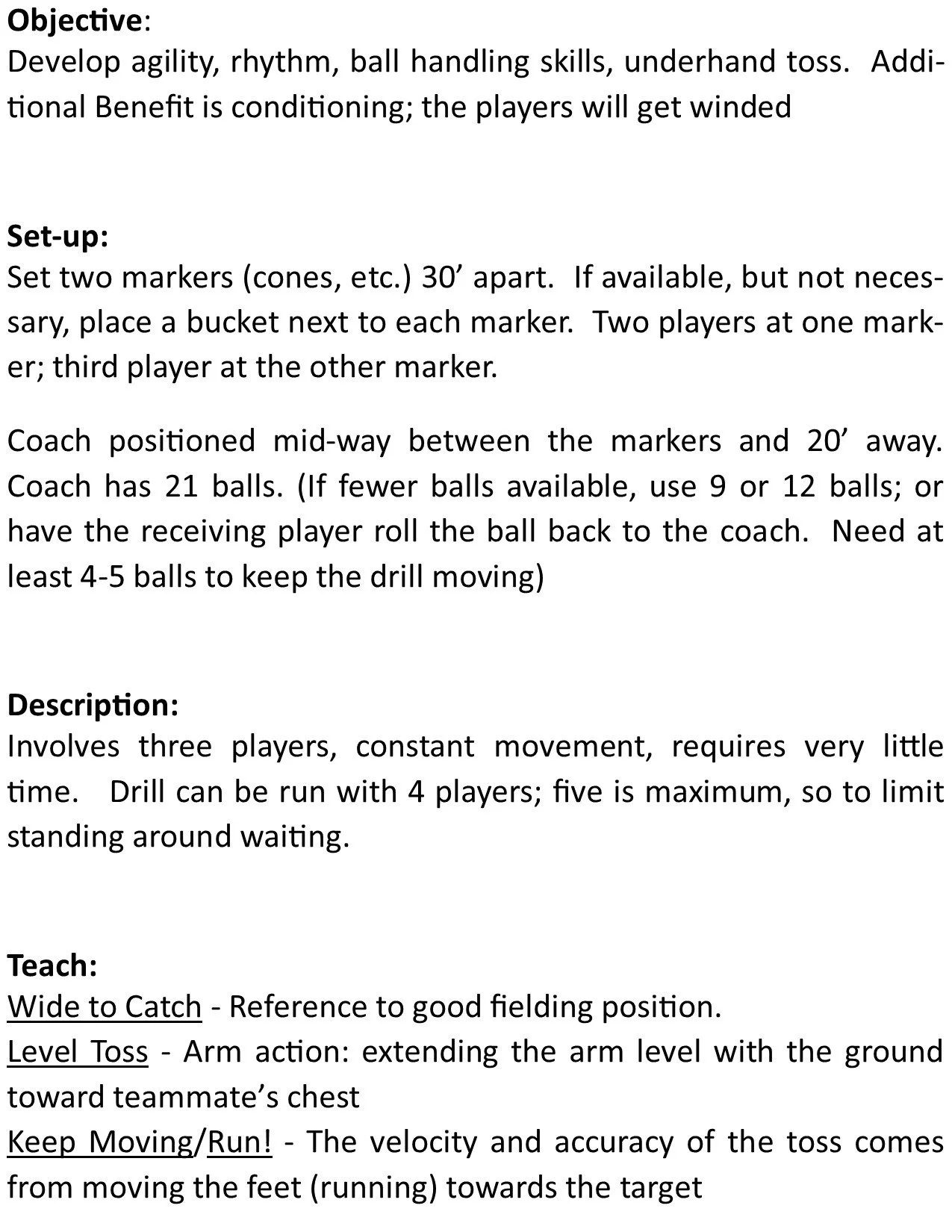
21 Ground Ball Weave

3-6 Play
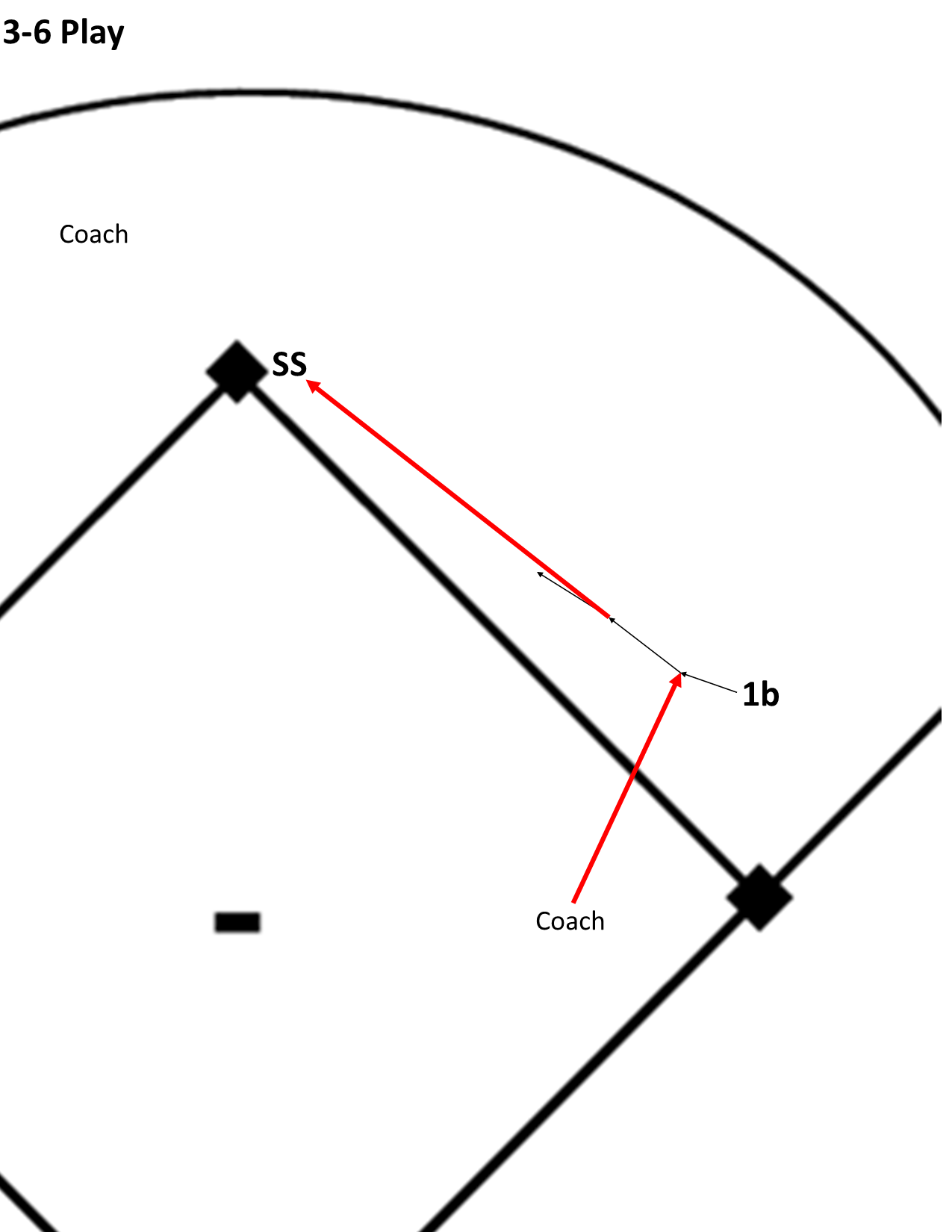
A common flaw in throws made by kids is not generating, and maintaining, Momentum Straight towards their target. A play that is especially challenging (from the standpoint of footwork discipline) is a Right-handed First Baseman making a throw to second base for a force out …the 3-6 Play.
Objective
With a base runner at first base and the ball hit to the First Baseman, we want to get the lead runner out at second base (keeping them out of scoring position), rather than going to First Base for the out.
Through repetition, our First Basemen develop confidence that they can successfully make a play on the lead runner.
Footwork
After fielding the ball, the First Baseman steps across their right foot with their left foot. The end of this action has their glove-side shoulder facing second base (their target).
Make a quick, powerful shuffle straight towards second base (Move Feet to Throw)
Throw with extra emphasis on the wrist snap. The effort in the throwing action is ‘Medium’ with the arm; ‘Fast’ with the wrist ...an accelerated action: arm-wrist.
Allow the momentum of the body to continue straight towards second base, for a couple of steps, after making the throw.
The effort with the legs and the momentum after making the throw are critical points for making an accurate throw. It is the responsibility of the coach to constantly remind the players to ‘Move Your Feet’ and ‘Continue Momentum Straight Towards the Target’.
If available, put an extra coach beyond second base. This coach, with great emphasis, motions to the first baseman to continue their momentum towards the target after the throw is made. Remember, young kids think throwing is exclusively an arm action; we need to train them to maximize their leg strength.
Drill Set-up
First Baseman: 10’ off the base/foul line, either:
10’ behind the baseline (running between first and second bases)
A couple feet in front of the baseline
Coach: 20’ from the First Baseman
Shortstop: on the same side of the baseline as the First Baseman (we do not want the throw to cross the path of the runner). Heel of the foot closest to the baseline next to the front, outside edge of second base (not touching the base)
Coach #2 (if available): Approximately 15’ beyond second base
Extra players: to rotate in at First Base and Shortstop (ideally just one extra player at each position; we don’t want players standing around ‘waiting their turn’). This is a drill that is run as part of a ‘3 Groups Drill’.
Drill
Coach: roll the ball 4’-5’ to the First Baseman’s right.
First Baseman: field the ball, execute their footwork and throw (our main objective is to develop the footwork for this play).
Shortstop: sets up in a Ready Position, Moves Feet to Catch (if necessary - Ball First, Base Second), Reaches Forward to Catch, slides foot against, or onto, the edge of the base.
…rotate next set of players into the drill
Note 1: if you want to work players at both positions, the First Baseman, following their momentum, continues to second base. Shortstop rolls the ball back to the coach while running to a waiting spot near first base.
Note 2: If the throw gets past the Shortstop, Do Not chase the ball (the coach has plenty of extras; we don’t want to delay moving on to the next drill repetition)
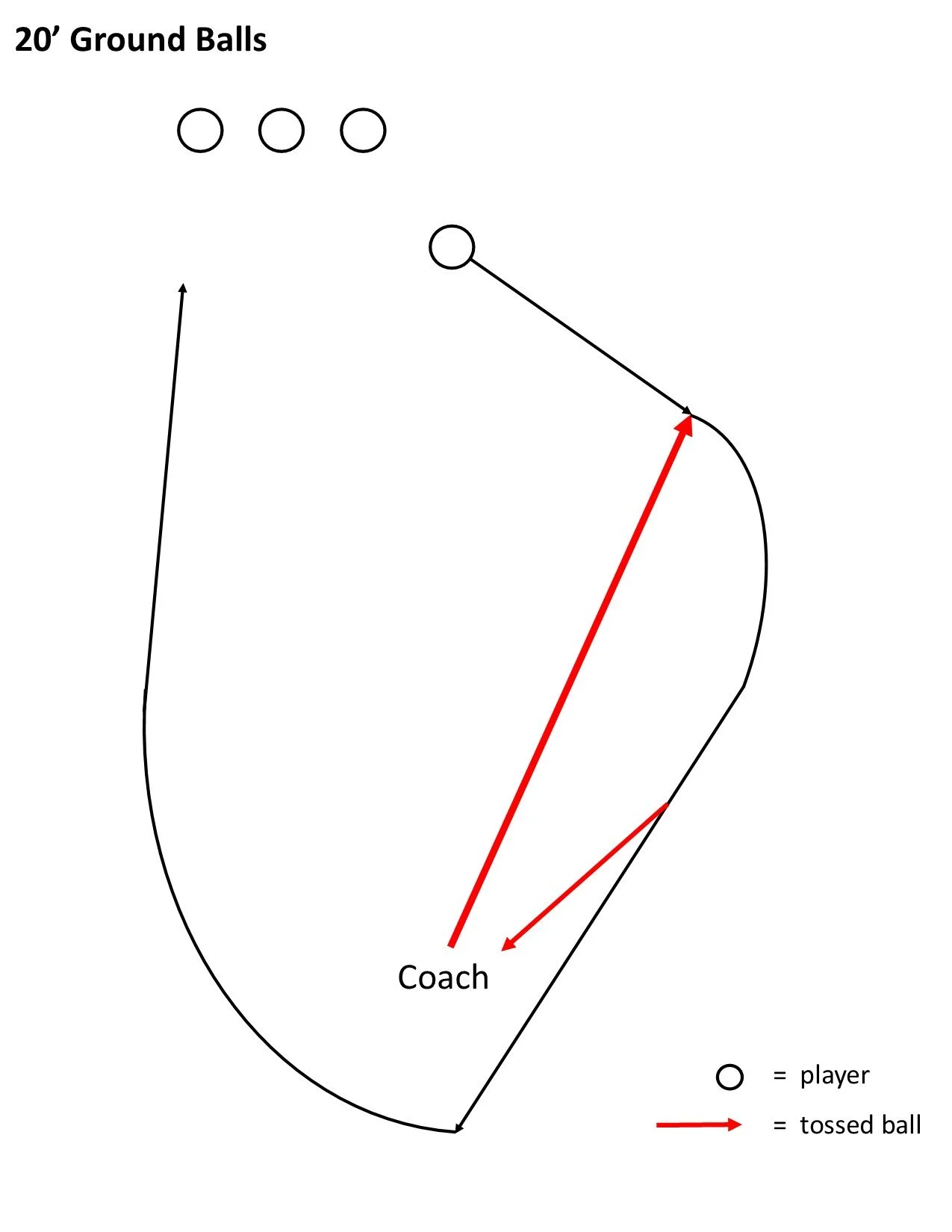
20’/50’ Ground Balls

Ground Ball Fielding Technique
(‘Your feet make your hands work’)
Footwork is the foundation of sound ground ball fielding technique. We want the feet moving throughout the process of approaching, catching the ground ball, and throwing the ball ...‘Your feet make your hands work’.
Feet: ‘Fast, Slow, Fast’ - fast to the ball, slow down to catch the ball, fast feet (momentum straight towards the target) to throw the ball
’Feet Wide to Catch’- the wider the feet, the closer the hands and butt are to the ground.
Get in front of the ball to catch the ball’ - don’t get in front of the ball until the last step before fielding the ball. When a player gets in front of the ball too soon, the feet stop moving. Stay to the side of the ball when approaching the ball. Step in front of the ball to catch to catch the ball.
Major League Shortstops - Fielding Footwork (VIDEO)
The first 1:30 is a Series of short clips (1-2 seconds each), at regular speed, illustrating the ‘Fast-Slow-Fast’ footwork rhythm of the ground ball fielding action.
First Clip - watch for ‘Move Feet to Throw’ resulting in the player ‘Gaining Ground’ towards their target.
Second Clip - watch the player get their ‘Feet Wide to Catch’. They ‘Step in Front of the Ball to Field the Ball’
0:18-0:24 - Four clips in a row where the ‘Fast-Slow-Fast’ Rhythm of the Feet is quite clear to see.
A. Fast - note the quick choppy steps preparing to catch the ball
B. Slow - players actions throttle down to make the ‘Wide Feet to Catch’ action ...under control
C. Fast - player ‘shuffling’ feet towards the target, generating power for the throw
The second half of the video (1:30 - 3:20) shows the fielding action is slow motion.
Reading Hops (older kids / more experienced players)
…note which part of the hop fielders catch the ball in the video above
Short hop (ball hitting the ground just in front of the glove)
Top of hop
Downside of hop (not ideal, but sometimes it’s the best a fielder can do)
VIDEO - Underhand Toss (watch: 0:00-0:10)

Ranging Laterally


Replaying The Ball


Throwing Across
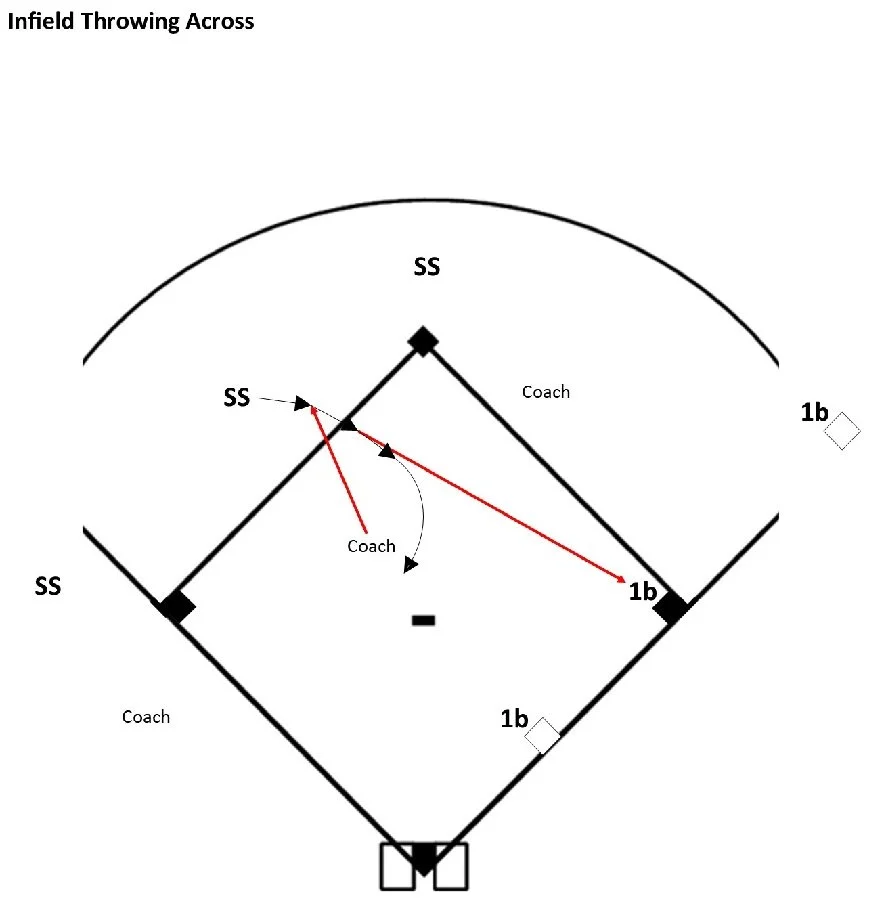
Objective
Mass reps of the process of fielding (footwork) and throwing across the diamond
Actions
Fielding: Fast, Slow, Fast footwork rhythm
Throwing: Make a quick, powerful shuffle straight towards first base (Move Feet to Throw)
The effort in the throwing action is ‘Fast’ with the arm; ‘Faster’ with the wrist ...an accelerated action: arm-wrist.
Allow the momentum of the body to continue straight towards first base, for a couple of steps, after making the throw.
The effort with the legs and the momentum after making the throw are critical points for making an accurate throw.
It is the responsibility of the coaches to constantly remind the players to ‘Move Your Feet’ and ‘Continue Momentum Straight Towards the Target’ after making a throw.
If available, put an extra coach in foul territory on the first base side. This coach, with great emphasis, motions to the Shortstops to continue their momentum towards the target after making a throw. Remember, young kids think throwing is exclusively an arm action; we need to train them to maximize the power in their legs.
Note: this needs to be a nimble coach who can bounce up and down the line communicating with Shortstops in all three groups.
Drill Set-up
Throw Down Bases (or anything to represent a base):
Midway between home plate and the actual first base
30’ beyond the actual first base
Cones/Markers indicating where each Shortstop needs to be prior to their coach rolling the ball
Shortstops (three groups)
In foul ground on the third base side
Actual SS position
5’-10’ on the right field side of second base
Coaches (3)
20’ from each Shortstop
First Basemen (3)
In a Ready Position at their base; eyes on the coach and Shortstop. Be prepared to receive throws in rapid-fire fashion
Drill
FIRST: alert all players that this is a fast-moving drill. First Basemen will have balls coming at them every 7-8 seconds. Shortstops waiting need to pay attention and get in a Ready Position at the cone/marker the moment the player ahead of them moves to field the ball. The Shortstop who just fielded the ball and made a throw needs to immediately get out of the way of the next throw.
Coaches
First, make sure each group of Shortstops are clear on which First Baseman they are throwing to, and that each First Baseman knows which group of Shortstops is throwing to them
Roll balls to their group of Shortstops, same as the 20’ Ground Ball Drill
We want a ball fielded and thrown every 7-8 seconds
Note: watch the throws to First Base; be sure the First Baseman will be ready when the ball is rolled to the next Shortstop. ***Likely the First Baseman will need to be reminded to not worry about touching the base; and be reminded to get ready for the next throw.
First Basemen
Set up in a Ready Position, Moves Feet to Catch (Ball First, Base Second), Reaches Forward to Catch. If the ball is offline, Do Not be concerned with touching the base, just catch the ball. If the ball is uncatchable, let it go …DO NOT chase the ball.
Balls that are caught are rolled back to the coach running their group. Quickly set up at the base; the next ball will be coming in 7-8 seconds.
Note: the first time running this drill consider having adults taking throws. Initially kids playing First Base likely will not be focused enough to get rid of the ball they just caught and be alert for the next throw. Also, they may be fighting the urge to have their foot on the base when catching throws. This is not a First Base footwork drill. The role of the First Baseman is to give the Shortstops a target to throw to. The First Baseman get a lot of reps catching throws (which is good). They also get experience executing the ‘Ball First, Base Second’ concept.
Shortstops
Field and Throw, per points noted above in ‘Actions’. After completing a couple steps of momentum towards their target after they throw, circle around behind the coach, getting out of the path of the next player’s throw. Quickly get back to their position; they will be fielding a ball every 15-20 seconds.